Product reviews and ratings, what shoppers read and how to show them
What product reviews tell shoppers, how to show star ratings on the product page, and what to do when a product has only a few reviews or none yet.
In this article
Reviews are the part of a product page the store does not write. That is why shoppers read them, and why the way you collect and show them matters as much as the stars themselves. This article covers what published research says reviews do for a shopper, how to show them on the product page, what to do when a product has few or none, and which shortcuts we never recommend.
What reviews tell a shopper
A product description says what the store wants the buyer to know. Reviews answer different questions. Does the size run small? Did the colour match the photos? What went wrong for the people who were unhappy?
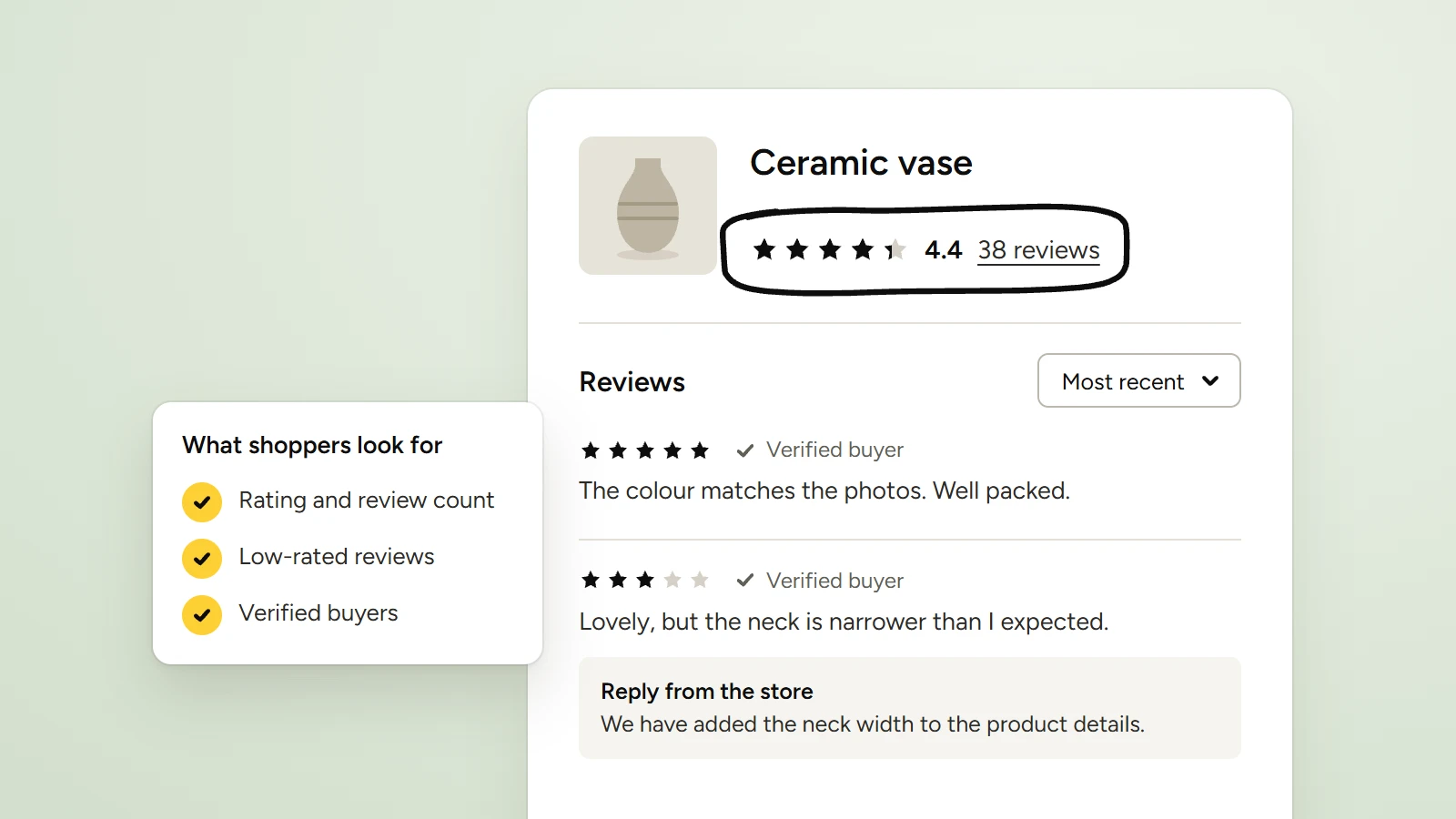
Nielsen Norman Group's product page guidelines (Katie Sherwin, 2019, based on research across 49 ecommerce sites) describe what shoppers were looking for. They wanted reviews that covered both good and bad points and were easy to scan. Many wanted to jump straight to the negative reviews, to see the worst that could happen with the product. Sorting and filtering tools were used often. Details about the reviewer, such as their size or how they used the product, helped shoppers decide whether a review applied to them. Showing which reviews came from verified buyers helped build trust.
The same study found that mixed reviews did not necessarily put people off. One shopper kept considering a smartwatch because the positive points outweighed the negative ones.
Why reviews matter
Ratings and purchase decisions
The Medill Spiegel Research Center at Northwestern University published a report called "How Online Reviews Influence Sales" in 2017. Its web page was republished in December 2025. The report found that the likelihood of purchase rose quickly as a product's first reviews appeared, and that the extra benefit of each new review fell off fast after the first five. Reviews made a larger difference for higher-priced products than for cheaper ones.
The report also found that purchase likelihood was typically highest for average ratings between 4.0 and 4.7, and that it fell as ratings approached a perfect 5.0. The researchers' reading is that a perfect score can look too good to be true. They describe negative reviews as a source of credibility and authenticity, and they advise retailers to keep them rather than hide them.
The data behind these findings is now several years old, and the page does not give sample sizes. We use it for the direction of the findings, not for exact figures.
Reviews and sales over time
An earlier academic study points the same way. Judith Chevalier and Dina Mayzlin compared customer reviews of books on two large online bookstores (NBER working paper, 2003). Better reviews were associated with higher relative sales on the site where they appeared. A one-star review had a larger effect than a five-star review. Reviews on both sites were mostly positive.
Who writes the reviews
A second Spiegel Research Center study, built on data from the review software company PowerReviews, compared two groups of reviewers. Verified buyers, who wrote after an email asking them for a review, gave an average of 4.34 stars. Anonymous reviewers, whose purchase could not be linked to a request, gave an average of 3.89 stars and wrote a larger share of one-star reviews. According to PowerReviews' own data, most of its reviews came from post-purchase emails.
The point for a store owner is simple. People who write a review unprompted tend to have strong feelings, often negative ones. Asking every buyer, in the same way, gives a fuller picture of how the product is received.
How to show reviews on the product page
The research above suggests a fairly settled pattern:
- Rating and count next to the product name. The average rating and the number of reviews, shown near the top, with a link that jumps to the reviews. A rating without a count tells the shopper little.
- Sorting and filtering by rating. Let shoppers go straight to the lower ratings, and let them sort by date.
- Context about the reviewer. Where it fits your products, ask for details that help others judge relevance: size usually worn, how the item was used, how long it has been in use.
- A verified buyer label. Use it only for reviews that really match a purchase record.
- Negative reviews kept in place. Publish them like any other. Our own suggestion is to add a short, calm reply that says what you did about the problem, so other shoppers can see how you handle one.
- The same rating in search results and on the page. Google's documentation for review snippets says the reviews you mark up must be easy for users to find on the page, and an aggregate rating you mark up must be visible there too. The minimum markup is the average rating and either the number of ratings or the number of reviews. Google also says there is no promise that features based on structured data will appear in search results.
On a phone, we check that the rating sits near the product name and that tapping it leads to the reviews, rather than to the top of a long page.
When a product has few or no reviews
Every new product starts here, and it is a normal stage, not a fault. The research gives a useful hint. The Spiegel report found that the first few reviews make the biggest difference, so the aim is to collect real reviews steadily from the start.
Things that fit the evidence and the guidance:
- Ask every buyer after delivery. One short email, sent to all buyers once they have had time to use the product, with a direct link to the review form. The Spiegel study shows this brings in reviews from a wider group than people who come back on their own. The US Federal Trade Commission's guidance on its consumer reviews rule says the rule makes an exception for a general request sent to purchasers asking them to review their experience.
- Ask in the same way, whatever you expect the answer to be. Do not send the request only to customers you think are happy.
- If you offer something in return, make it not depend on the rating, and say so. The FTC's guidance says incentives may not require a particular sentiment, and the UK Competition and Markets Authority's short guide says incentives should not be concealed. Spiegel's own advice is to disclose any incentive on the site.
- Keep empty stars from shouting. When a product has no reviews yet, a row of grey stars and "0 reviews" next to the name takes up space and says nothing. A review section lower down, with a plain invitation to write the first review, is enough. This is our view of good practice, not a research finding.
What we never recommend
Some shortcuts look tempting when a page has no reviews. We do not recommend any of them, and they fall under patterns that regulators describe in their own guidance:
- Reviews written by the store, staff, friends or family without saying so. The FTC's guidance says reviews by insiders must clearly disclose the relationship.
- Reviews bought from a service, or reviews that do not reflect a real experience. The CMA's guidance asks businesses that publish reviews to take reasonable and proportionate steps to prevent and remove these.
- Showing only positive reviews, or arranging them so negative ones are hard to find. The FTC's guidance says sorting reviews is not in itself suppression under its rule. FTC staff add that arranging reviews so shoppers cannot easily find negative ones could still be treated as unfair or deceptive under wider US law.
- Invented activity messages such as "someone just bought this" or "12 people are looking now" when they do not come from real data.
We are not lawyers, and these are short summaries of what each body's own page says. If reviews are a large part of your store, read the guidance for the countries you sell to and ask a lawyer how it applies to your store.
How to check your own store
Work through these on a phone first, then on a computer.
How we look at it
When we review a store, we open product pages from several categories and note whether reviews are shown, where the rating sits, whether the count is visible and whether shoppers can reach the lower ratings easily. We also compare the rating shown on the page with the one given to search engines. You can read more about what we check on product pages, or see how we work.
If you would like us to look at your product pages this way, you can request a report.
Request an auditSources
- Nielsen Norman Group, Katie Sherwin (2019). UX Guidelines for Ecommerce Product Pagesnngroup.com
- Medill Spiegel Research Center, Northwestern University (2017, page republished 2025). How Online Reviews Influence Salesspiegel.medill.northwestern.edu
- Medill Spiegel Research Center, Northwestern University (page dated 2021). Self-Motivated vs. Prompted Reviewsspiegel.medill.northwestern.edu
- Chevalier and Mayzlin, National Bureau of Economic Research (2003). The Effect of Word of Mouth on Sales: Online Book Reviews, Working Paper 10148nber.org
- Google Search Central. Review snippet (Review, AggregateRating) structured datadevelopers.google.com
- Federal Trade Commission (2024). The Consumer Reviews and Testimonials Rule: Questions and Answersftc.gov
- Competition and Markets Authority (2025). Short guide for businesses: publishing consumer reviews and complying with consumer protection lawgov.uk